Is Node.js Good for the Backend? The Pros and Cons of Node.js for Different Project Types
Published: – Updated:

If your plan is to build a product that will last for years and scale, Node.js will definitely be among your shortlisted backend technologies. It can’t be running Netflix’s API layer and PayPal’s checkout and be used by over half of backend developers for nothing; it must be well suited to build systems that scale.
But its solid resume alone isn’t enough to decide. You need to know whether it fits your workload and what it will cost you. With this article, we answer these and many other questions that will help you understand whether to choose Node.js as your next project’s technology.
Should you use Node.js: Quick answer
Node.js’s strength is holding many open connections and moving data through them quickly. Its weakness, in turn, is its limited ability to do heavy work inside a single request while everything else queues behind it. Nearly every recommendation and argument that will follow in this article will be based on this contrast, and before we move on, you need to know how to analyze your project in this context.
Use this list as your cheat sheet and starting point.
Node.js is well suited to:
- APIs serving many concurrent clients, especially when requests are I/O-heavy.
- Real-time applications with features such as chat, live updates, notifications, or tracking.
- Projects where the frontend already uses JavaScript or TypeScript. Teams can work across the stack with the same ecosystem.
- Microservices and serverless functions, where lightweight, event-driven services are useful.
- Products where time to market is more important than maximizing per-request efficiency.
Consider alternatives when:
- The core workload involves heavy computation or intensive data processing.
- The application requires hard latency guarantees at the microsecond level.
- You’re training or serving machine-learning models at scale.
- The team already has significantly deeper expertise in Java, .NET, or Python.
- You need a framework that enforces a strong application structure out of the box.
What is Node.js?
Let’s start moving on by defining Node.js technology. Node.js is an open-source, cross-platform JavaScript runtime environment. It runs JavaScript on a server, not just in a browser, which makes it one of the most widely used backend technologies today. Doing your research, you might see its name written in different ways (Node.js, Node js, and nodejs, to name a few); they all refer to the same runtime.
Now to the history. Ryan Dahl created Node.js in 2009. His goal was to build network servers that would be able to handle thousands of open connections at the same time. In his own words, the idea was to let developers quickly put together servers and clients. That original design choice is still a key reason to consider Node.js. Most of its characteristics – fast performance, flexible syntax, efficient code sharing, and regular library updates – stem from the way it handles concurrent operations.
What does that mean?
- Developers use one language across the stack. Frontend and backend teams can write, review, edit, and share code in JavaScript.
- It has high concurrency on modest hardware. Node.js can handle many simultaneous connections without creating a dedicated thread for each request, reducing memory overhead.
- Fast startup and small containers. Node.js applications can start quickly and run with relatively little overhead. This matters for serverless workloads, where cold starts add latency.
- It has a vast package ecosystem. npm has grown to more than 4 million published packages, giving developers a large pool of reusable libraries and tools.
- Predictable support windows. Node.js 24 is an active LTS release. The security support is scheduled to continue through April 2028.
How does Node.js architecture work
Node.js uses an event-driven, non-blocking architecture. JavaScript code runs on a main thread, which processes incoming requests and events. When a request needs to wait for something slow, such as a database query, file operation, or external API call, Node.js can hand that work off and continue processing other events instead of blocking the main thread.
You can compare it with a traditional thread-per-request model. A server creates a separate thread for each request, and all those threads consume system resources, especially memory. Node.js can keep numerous operations in flight while using relatively few threads, making it well suited to workloads with many concurrent connections.
That is why Node.js is frequently used for chat applications, live dashboards, streaming services, and API gateways. These systems spend much of their time waiting for I/O rather than performing continuous CPU-heavy computation.
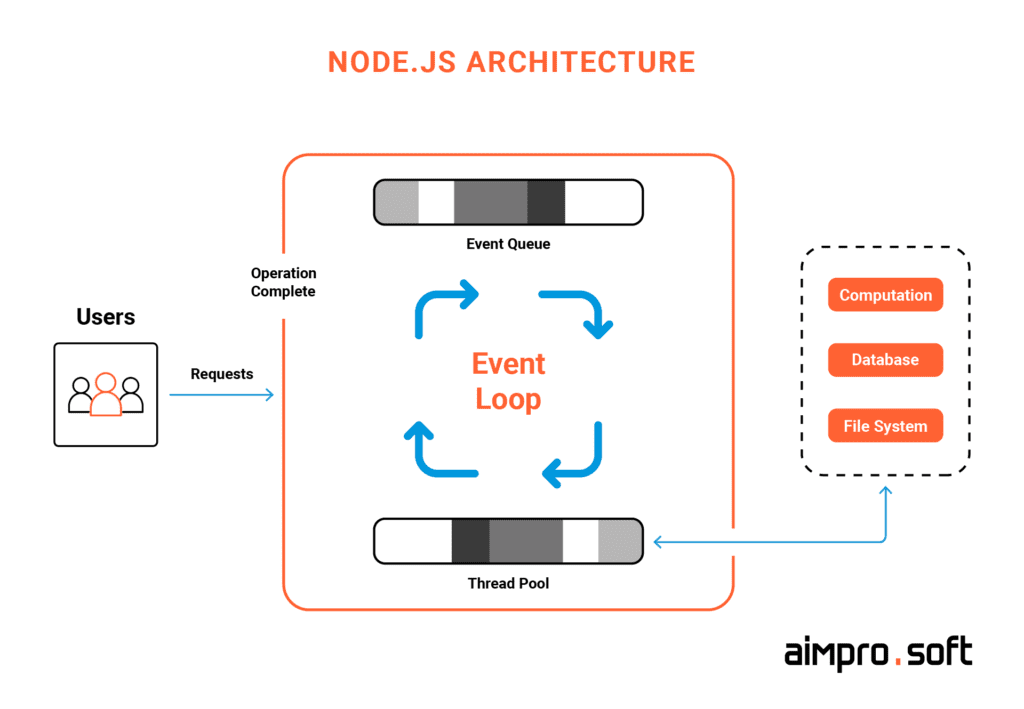
Beyond these basics, there are two things to remember:
- JavaScript isn’t your only option. Node.js can run code that compiles to JavaScript, including TypeScript. Since Node.js 22.6, the runtime has supported lightweight type stripping for TypeScript files, and Node.js 24 made this capability available without the experimental warning. For supported TypeScript syntax, you can run .ts files directly without a separate transpilation step.
- Node.js isn’t only for servers. It is also widely used for command-line tools and desktop applications. The same runtime and package ecosystem can power software that runs on servers, developers’ machines, and end-user devices.
Why is Node.js so popular for backend development?
For two reasons: I/O performance and development speed.
At runtime, Node.js works by an event-driven, non-blocking model that lets it handle many I/O operations concurrently without assigning a dedicated thread to every request. For applications that spend much of their time waiting for databases, APIs, or other external services, this can use server resources more efficiently.
Node.js can also support persistent, bidirectional connections through technologies such as WebSockets. This allows servers and clients to exchange data without constantly establishing new connections. If the application you’re considering is chat, live dashboards, or any other real-time system, it’s a natural fit.
On the development side, using Node.js for the backend can give teams a common language and toolchain across the stack. Developers can conveniently share code and packages, and review code between frontend and backend projects. At the same time, organizations can hire from a broader pool of JavaScript developers.
Then there is npm. Its huge package ecosystem gives developers access to libraries and tools for a wide range of common tasks. When a team encounters a familiar problem, there is often an existing package that can reduce the amount of code it needs to build and maintain itself.
Four additional reasons to consider Node.js
- Microservices and modern architectures
Node.js applications can start quickly and run with relatively low overhead. This makes the runtime a good fit for microservices and serverless workloads. You can deploy, scale, and replace individual services independently, and serverless platforms can benefit from Node.js’s fast startup times.
- Faster time to market
More than 3.1 million packages are published on npm to help developers with authentication, validation, queues, payment integrations, and PDF generation. That reduces the functionality a team needs to build and maintain, leaving more time for product-specific work.
- More functionality built into the runtime
Node.js has added features that previously often required separate tools or packages. Those are a built-in test runner, native file-watching support, .env file loading, and a WebSocket client. It also supports TypeScript type stripping, allowing supported TypeScript files to run directly without a separate transpilation step. Fewer dependencies can mean less maintenance and a smaller dependency surface to monitor.
- Great for real-time applications
Node.js is well suited to applications that maintain many concurrent connections and frequently exchange data, including chat, live collaboration, notifications, multiplayer applications, and real-time tracking. Its event-driven, non-blocking architecture is particularly effective for workloads involving frequent I/O and persistent connections.
Is Node.js a backend or frontend technology?
Node.js is a backend runtime. It runs JavaScript on the server and handles HTTP requests, database access, authentication, and business logic.
The confusion comes from Node.js also powering frontend tooling. Bundlers, test runners, linters, and build scripts run on Node.js during development and CI. Your React or Angular application ships to the browser as JavaScript. Node.js itself doesn’t run in the browser.
Node.js gives teams the advantage of using the same language across the stack. Frontend and backend developers can move around their work without learning another language, which can be particularly useful for smaller teams. Our guide to hiring offshore Node.js developers covers what to look for when building that team.
What is the future of Node.js development?
Many factors suggest that Node.js will remain relevant across backend and full-stack development for years to come.
First of all, it’s the best choice for modern AI applications, and everyone needs an AI app now. Those applications usually spend more time communicating with model APIs, databases, and other services than performing model inference. And I/O-heavy, streaming workloads fit Node.js’s event-driven architecture. Node.js is a great option in the application layer, with Python and other languages handling model development or inference.
Second, Node.js remains a widely supported runtime for serverless platforms, such as AWS Lambda, Google Cloud Functions, and others, including several edge platforms.
Next, Node.js can cover more of the development workflow out of the box, potentially reducing a project’s dependency count. This is because it absorbs capabilities developers previously handled through separate packages or tools.
Pros and cons of Node.js compared to other technologies
As we’ve already established, Node.js offers an advantage of using one language across the stack, strong concurrency for I/O-heavy workloads, broad platform support, a large talent pool, and predictable LTS releases. Those are very solid pros, but we must name the cons, too.
- CPU-heavy work can block the event loop
Node.js handles I/O efficiently, but CPU-intensive JavaScript still runs on the main thread. If you expect your app to transcode video or transform large amounts of data, expect delays for other requests. A popular way to handle this is to use worker threads to move CPU-intensive work off the main thread. But they add architecture to design and maintain, so you should weigh your resources and timelines.
- npm brings a supply-chain trade-off
The npm ecosystem gives your developers their hours back, but every dependency adds another component to track and secure. Numerous compromised packages and stolen maintainer credentials have already made the software supply chain a security concern.
To manage these risks, you’ll need lockfiles, dependency auditing, controlled package policies, and appropriate runtime restrictions. As the dependency tree grows, so does the importance of this process.
- Node.js provides a runtime, not an app framework
Node.js does not prescribe a project structure. It also doesn’t provide a built-in ORM or enforce application conventions. That extra flexibility works for small projects, but large teams and long-lived codebases usually benefit from more structure.
NestJS and similar frameworks add those conventions on top of Node.js, giving teams a more opinionated architecture without abandoning the Node.js ecosystem. Our custom Node.js backend development services start with a technical review to assess that trade-off against your roadmap.
Node.js vs Python
In the most recent Stack Overflow Developer Survey, 49.1% of developers used Node.js as a web technology, and 54.8% used Python as a programming language. We can’t directly compare those numbers because the Python figures include developers who may not work on the web at all, but an overall picture is still clear. Node.js vs Python is a clash of titans. And it starts with their ecosystems: npm features more than 3 million published packages; Python’s ecosystem is unmatched in data science and machine learning.
I/O-heavy systems benefit from Node.js. An event-driven, non-blocking model works well for APIs that handle many concurrent connections, real-time features, streaming, and backend-for-frontend layers. Teams can also use JavaScript or TypeScript across the stack with different frameworks.
Data-heavy systems call for Python. It shines when backend work overlaps with data pipelines, ML, scientific computing, or content-heavy applications. Python’s ecosystem includes Django, Flask, FastAPI, and PyPI – a profound selection of data-science and ML libraries.
Is Node.js enough for backend development?
Node.js would be enough for most web and mobile products. Companies that serve hundreds of millions of users run production backends entirely on this technology. A Node.js backend handles authentication, business logic, database access, third-party integrations, file handling, background jobs, and real-time delivery without a second runtime.
Where it stops being enough is when your product does heavy numerical computation or trains or serves ML models at scale. But even then, the usual practice is to keep Node.js and delegate the heavy lifting to a specialized service.
Most popular Node.js backend frameworks
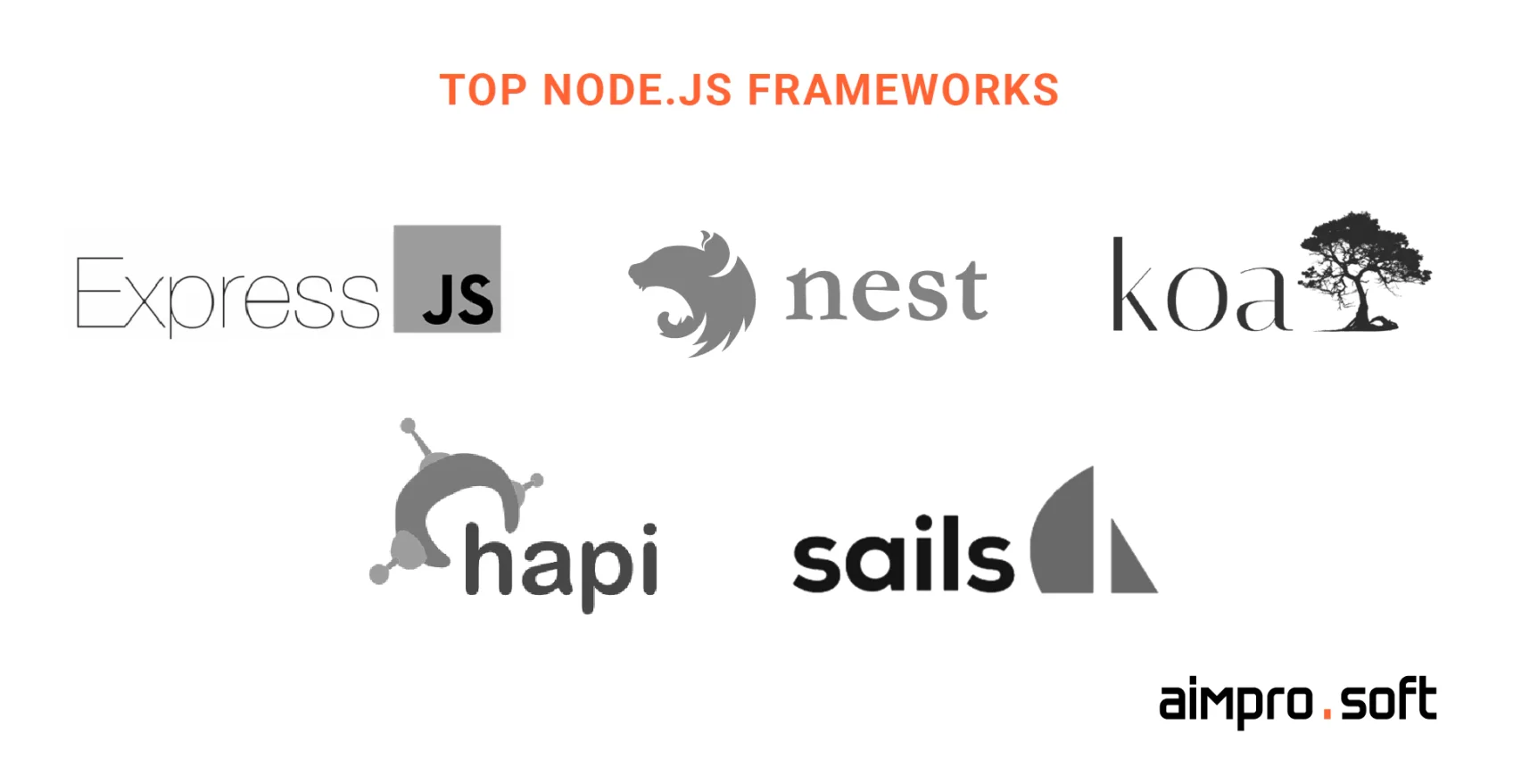
Express is the most-used Node.js framework, with 20.3% adoption among professional developers in the 2025 Stack Overflow Developer Survey. It is flexible and easy to start with, but large projects need their own conventions to stay organized.
NestJS (7.4%) adds structure through modules and controllers, making it a natural fit for enterprise applications and microservices. The learning curve, however, is steeper.
Fastify (3.1%) focuses on performance. It has low request overhead and schema-based validation. Consider it when you need to monitor API throughput and infrastructure costs.
Koa and Hapi. Koa keeps the core minimal, while Hapi delivers a more configuration-driven architecture. They are rarely used in new projects.
For a broader look at building a Node.js stack, see Aimprosoft’s Node.js expertise.
When to migrate your project to Node.js
Migration to Node.js generally costs more than starting a new Node.js project, because we are talking about a complete, working system. But in some cases, migration is a better option despite the cost. For example:
- Your stack is difficult to maintain. It’s hard to find experienced developers for an outdated language or framework, and maintenance costs can rise quickly. If you run a 10–15-year-old product, compare the constantly growing cost of keeping the existing system with the one-time cost of moving to a stack with a larger talent pool.
- Your frontend already uses JavaScript. If your React, Angular, or Vue application has a different backend language, moving to Node.js can give the team one language, toolchain, and set of conventions across the stack.
- Your product needs real-time features. Implementing chat or live updates can reveal limitations in a backend that wasn’t designed for these workloads. If supporting them requires increasingly complex workarounds, you may want to evaluate migration.
Aimprosoft as your Node.js backend partner
We’ve worked with Node.js since its early versions, across 600+ released projects and 20+ industries. To each Node.js project, we bring:
- 20+ years of experience
- 600+ projects released
- 80% of clients return for new projects
- 100+ active clients across the US, Europe, Canada, and Asia
- 80%+ of engineers working with JavaScript, with around half working full-stack
Our Node.js portfolio
We’ve been working with Node.js since its earliest versions, so we can boast a track record of successfully released projects. Here are just a few examples of them:
Pr.business
The client came to us with the request to create a local-search directory from scratch that would be capable of aggregating information about local SMBs and managing digital listings from Foursquare, Yelp, Google my Business, and others. As a result, our developers created a digital hub for PR and marketing firms focused on the B2B industry. Its objective is to keep track of a company’s online reputation. The system gathers evaluations and comments from all widely used platforms. have a flexible search interface and adaptive design. Users can review and verify listings for various commercial products.
Tech stack: Node.js, Java, Redis, Docker, Kubernetes, Google Cloud Platform, Angular, React, Responsive design, Schema.org, Prerender.IO
Centralized healthcare platform
The client came to us with an idea and preferences for the tech stack. The requirements were to develop a web product that would allow dentists to post cases using a digital prescription, choose a lab from the list to complete them, pay and rate labs, and more. Our developers built an incredible web-based platform that enables seamless collaboration between dental labs and practitioners. In return, labs get hands-on tools to create accounts, view and offer dental cases, interact with dentists, and get the data they need.
Tech stack: Node.js, PostgreSQL, Hapi, Sequelize, Redis, React, Webpack, AWS EC2, AWS S3, PM2, IntelliJ IDEA, Git
B2B portal for waste collection services
The client came to us with only a concept; therefore, we built it from scratch. As an outcome, our programmers have developed a platform is designed for regular businesses and garbage haulers. It offers a market, the option to bid, the ability to select the best offer and then to sign a contract, as well as the capacity to control the process for the duration of the contract.
Tech stack: Node.js, Java, PostgreSQL, AWS S3, Spring, Spring MVC, Spring Security, Spring Boot, Hapi, Domain Object Security (ACLs), OAuth, Hibernate, Sequelize ORM, Bluebird, Enzyme, React, Reflux, Redux-Saga, Bootstrap, Webpack, Stripe, Google Maps, Karma
Conclusion
To sum it up, Node.js has the world’s largest open-source package repository and a strong developer community, both of which speed up development. Getting started with Node.js can be very easy if you put your development in good hands. Contact Aimprosoft, and we will offer the best solution for your future Node.js project.
FAQ
Is Node.js a backend or frontend technology?
Node.js is a backend runtime. It runs JavaScript on the server and handles requests, database access, authentication, and business logic. It also powers frontend tooling such as bundlers and test runners, but the JavaScript running in the browser is not Node.js.
Is Node.js enough for a backend on its own?
For most web and mobile products, yes. Node.js can handle authentication, business logic, databases, integrations, file processing, background jobs, and real-time communication. A separate runtime may make sense for workloads such as heavy numerical computing or ML model training and serving.
Node.js vs Python for the backend, which is better?
Neither is universally better. Node.js is well suited to high-concurrency APIs, real-time features and streaming, while Python has a particularly strong ecosystem for data science, machine learning and scientific computing. Some AI products use Node.js for the application layer and Python for model services.
Which Node.js version should we run in production?
Node.js 24 is the current Active LTS line, with security support scheduled through April 2028. Node.js 26 is the current release and is scheduled to enter LTS in October 2026. Node.js 22 is in Maintenance LTS and reaches end of life in April 2027.
What kinds of applications use Node.js?
Node.js is commonly used for REST and GraphQL APIs, real-time messaging and collaboration, streaming, IoT data ingestion, SaaS dashboards, AI application backends, and multiplayer applications.
What are some well-known Node.js users?
Netflix, PayPal, LinkedIn, Uber, eBay, Walmart, and NASA have all used Node.js in production, including for APIs and middle-tier services.
Why is Node.js popular with startups?
With a shared JavaScript or TypeScript stack, small teams can work across the frontend and backend. The npm ecosystem also offers reusable libraries for many common tasks.