
FRONTEND DEVELOPMENT SERVICES FOR AI-POWERED PRODUCTS
Your users have changed how they expect software to behave. They'd rather ask a question than dig through three menus. They expect answers to stream in as they're generated, suggestions that fit what they're doing right now, and some explanation of why the system did what it did. Almost all of that lives on the frontend. The model might run on a server somewhere, but people judge your product by what they see and click.
Our frontend development services cover that whole layer. We build and modernize interfaces in React, Angular, and Vue, ship AI features people trust, and use AI-assisted engineering to move faster without letting code quality slip. Our frontend developers also handle the part most frontend development agencies skip in the sales pitch, which is keeping a frontend healthy and current for years after launch.
When it makes sense to hire a frontend development company
You're adding AI to a product people already use, and the new chat, copilot, or search features have to fit your current UI without slowing it down or making users nervous
You're building an AI-native product. Here the interface is the product, so it must cope with streaming output, multi-step agent actions, human review, and things going wrong
Your frontend has become the bottleneck. Maybe the framework is several versions behind, maybe tech debt makes every change painful, or maybe there's simply no clean place to put AI features.
You're weighing a framework migration and want a partner who's already carried a production app through many major upgrades
You want AI coding tools in the mix, but only inside a real review, testing, and security process
You're considering frontend development outsourcing, offshore frontend development included, and want a dedicated frontend development team that works as part of yours
Recognize your situation here? Tell us which one and we'll send back a rough approach and timeline.
Frontend development services we provide
Our work falls into three buckets: the interfaces your product needs now, the AI features users increasingly expect, and an engineering process that uses AI to deliver both faster.
AI-powered frontend solutions

AI features and copilots
We build chat assistants, in-app copilots, smart search, summarization, content generation, and contextual suggestions right into your existing interface. Then we connect them to LLM APIs and your backend, so they run on your real data rather than a polished demo dataset.

Conversational and generative UI
Responses stream in as they're generated. Structured AI output shows up as tables, charts, forms, or cards, and users can tweak a result instead of starting over

Interfaces for AI agents and workflows
When an agent works through a task on its own, people need to see what it's doing and step in when it matters. We design progress views that show each step as it happens, approval prompts before high-impact actions, controls to pause the agent and edit its plan mid-run, and undo for actions where the backend supports it.

AI-ready frontend architecture
Before AI goes into an existing frontend, the groundwork must be in place. That means an API layer for model calls, state management that can handle long-running and streamed responses, cost and rate-limit handling, and guardrails against prompt injection and data leaking through the UI.

AI UX that earns trust
Source citations, clear signs when an answer is based on limited sources, feedback buttons, sensible behavior when an answer is wrong or slow, and clear labels on AI-generated content. These small details decide whether people are still using an AI feature a month after launch.

RAG and knowledge-base interfaces
Search and Q&A over your company's documents, with upload, filters, and source previews for every answer. Permissions are enforced at retrieval, not just in the UI, so people only get answers drawn from documents they're allowed to open.

On-device and in-browser AI
For privacy-sensitive, offline, or low-latency features like image processing, classification, or text help, we can run lightweight models directly in the browser using WebGPU and WebAssembly

Not sure which AI feature to build first?
AI-assisted frontend engineering

AI-assisted development
Our engineers use AI coding assistants for scaffolding, refactoring, and the repetitive stuff. Every change still goes through human code review, automated tests, and security checks, so you get shorter timelines without inheriting code nobody on the team understands.

Faster migration and modernization
AI-assisted code analysis and transformation make framework upgrades and legacy rewrites (jQuery, Dojo, AngularJS, older Angular versions) go quicker. We pair that with the upgrade-in-place approach we've already proven on long-running production apps.

Testing and accessibility
AI helps us write unit, end-to-end, and visual regression tests faster and run automated accessibility checks. Our engineers then review what comes back and fix the issues.

Design to code
Mockups and design systems turn into production components faster, and we check each one against your design tokens and coding standards.
See how we use AI coding tools without losing control of the code
Core frontend development

Custom frontend development
Interfaces shaped around your business goals and the people who'll use them every day

Web platforms and corporate sites
Frontend web development built around your actual product logic, not a template

Progressive web apps and single-page apps
App-like speed and interactivity in the browser

Migration and modernization
If your frontend runs on outdated tech, we upgrade in place wherever we can. What already works stays.
Stuck several versions behind? Ask about our upgrade-in-place approach.

UI/UX design and development
Design for classic screens and for AI-driven experiences, including conversational flows and patterns for how people and AI work together

API-driven frontend development
Connections to backend systems, third-party services, and AI model APIs, with documentation your team can follow

Enterprise frontend solutions
Micro frontends, design systems, and architectures that hold up as requirements get more complex

Performance optimization
Faster loads, fewer bounces, and a responsive UI even when AI features add slow or streaming workloads

Frontend and AI consulting
Help picking a stack, figuring out where AI will pay off, deciding whether to build or buy AI components, and ordering the work so you end up with a usable, accessible interface

React development
Component-based React frontend development for large, complex products. As part of our React development services, for example, we rebuilt a genebank management platform's frontend so day-to-day work is faster and simpler.

Angular development
This is where our experience runs deepest. Our Angular development services range from new builds to multi-version upgrades of apps already in production.

Vue development
Fast, maintainable interfaces for storefronts, marketplaces, and modernization projects, including the Vue and Nuxt builds we did for Europe's largest pet supply retailer
Frontend development solutions we've built
AI-powered products and features
Interfaces where AI does the heavy lifting and users stay in control
For an AI document platform, we built a Next.js admin console that handles 20,000+ files at once. We also built a React Chrome extension that grabs phone numbers, addresses, and selected text from any page and sends them to an AI-powered dialing platform. At Homelike, we worked on the platform where an AI chatbot now takes pressure off the support team. And at a postal sorting hub, operators watch camera-based parcel analysis appear on screen in real time.
Customer and partner portals
Self-service that takes work off the sales desk
For a $25B global power management company, we built a partner portal where wholesale distributors check orders, inventory, and project status from one dashboard. Server-side rendering keeps those pages quick. More than 1,000 PlatformX Communications partners now price, quote, and order connectivity through the Angular SPA we built to replace its Liferay frontend. And Optima Italia's 500,000+ customers pay bills and track utility usage in a portal we helped rebuilt from legacy PHP.
SaaS and enterprise web applications
Tools people keep open all day
We took Motive Retail's certification product from a desktop app to a Liferay portal and later to Angular 19, and we built the Angular interface for its dealer-approval platform. For a clinical trial management SaaS, we delivered the entire study-oversight UI.
Dashboards and data visualization
Big datasets you can read at a glance
A UK clean-energy retailer uses our B2B dashboard to match corporate electricity use to specific solar, wind, and hydro assets on a map. It's now live in four regions. Genesys researchers browse data on 4.3M+ plant samples through the React frontend we migrated them to, and a solar inspection platform relies on our map interface to render thermal imagery for farms with thousands of panels.
E-commerce storefronts
Built around how people actually shop
For Europe's largest pet supply and care retailer, we redesigned the marketplace, rebuilt checkout, and added grooming bookings plus a pet adoption finder, all on Vue and Nuxt. We extended a global electronics brand's SAP Spartacus storefront across European markets. A leading B2B workwear supplier grew sales 22% after our store upgrade.
Product configurators
Complicated products, simple choices
Our React configurator for a furniture-as-a-service provider is embedded in Salesforce and stays fast across 300,000+ SKUs. An electrical infrastructure manufacturer uses our Angular wizard to walk customers through configuring UPS and PDU equipment one step at a time.
Real-time and IoT interfaces
Live data, no refresh button
For Aroma360's smart diffusers, we built a React and Socket.IO interface to manage connected devices in real time. We also worked on a clinical trial meeting platform that runs live, pre-recorded, and hybrid events over WebSockets and Jitsi.
Content-driven websites
Fast pages that editors control and that search and AI engines can read.
We built the frontend for a major US news publisher with millions of readers. For a US investment insights platform, we added a headless CMS so the team can update content without touching code. Server-side rendering and clean structured markup keep content readable for both search engines and AI answer engines.
Desktop applications
Outside the browser
Aimchat, our own corporate messenger, runs on Electron alongside its web and mobile clients. For a security startup that works with law firms, we built a Windows agent that blurs the screen when a phone or an unauthorized person shows up, plus the Angular console that manages it. That product helped the startup sign 80 firms.
Embedded UIs and extensions
Frontend that lives inside someone else's product
We build Salesforce dashboards with Lightning Web Components for a European DIY retailer. For a retail tech vendor, we created a product-page widget that ships as a Salesforce Commerce Cloud marketplace plugin.
Design systems and component libraries
Consistency that grows with your team (and your AI coding tools)
We built a Storybook-documented design system on Kendo UI for a clinical trial management platform. Reekolect's component library lives in Storybook too, and an enterprise planning suite runs on the Carbon Design System. There's a side benefit here: a well-documented design system makes AI-assisted development far more accurate, because the generated code has clear components to follow.
Cross-platform and mobile interfaces
One codebase, every screen
Reekolect launched its web and mobile apps within nine months on Angular and React Native. For a European DIY retailer, we used Kotlin Multiplatform to build a B2B app for professionals and an energy tracker with real-time dashboards. Drivers at an Estonian railway manage trips offline on routes with no signal, and 300,000 families use a React Native math app we developed.
Frontend development tools and technologies we use
Frameworks and languages
React.js
Scalable, interactive interfaces with a huge ecosystem. It's also best supported by AI UI libraries (Vercel AI SDK UI, assistant-ui, CopilotKit).
Next.js and Nuxt
Server rendering and built-in server routes for streaming model responses, so API keys never reach the browser
Angular
Large enterprise apps that benefit from a strict, structured framework
Vue.js
Lightweight and quick to build with, whether it's an MVP or a big storefront
Svelte
High-performance components for ambitious apps
React Native
Cross-platform apps that feel close to native
TypeScript
Catches errors early and makes AI-generated code easier to review
HTML, CSS, and JavaScript
The foundation under every frontend we build
AI integration and tooling
LLM APIs
OpenAI, Anthropic, Google Gemini, Azure OpenAI, AWS Bedrock
AI frontend SDKs
Vercel AI SDK and LangChain.js for streaming, tool calls, and structured output
In-browser AI
TensorFlow.js, ONNX Runtime Web, Transformers.js, WebGPU
Tool interop
MCP servers and clients, OpenAPI-described tools, provider function calling
Real-time delivery
HTTP streaming (fetch + ReadableStream), Server-Sent Events and WebSockets for streamed responses
AI-assisted engineering
AI coding assistants built into our code review, CI, and testing workflows
How we approach frontend development
Building AI features people rely on
- An AI feature should make it obvious what the system is doing, show sources where it can, and let people correct or reject the output. If a response comes back wrong or slow, the rest of the interface should keep working.
- Security gets the same attention. Model API keys stay on the server. We sanitize and validate AI output before rendering it, and we work with the backend team on prompt-injection defenses and make sure the UI can't leak data through rendered links or images.
- Model calls can take several seconds, so we use streaming, progress states, caching of repeat requests, and optimistic updates for the user's own actions. We also plan around token costs and rate limits from the start.
- When AI writes code for us, that code goes through the same review, testing, and security scanning as anything a person wrote. Our engineers are accountable for every line that ships.
Architecture and everyday engineering
- We manage state (user input, app settings, external data, and long-running or streamed AI responses) with tools like Redux, NgRx, Pinia, Zustand, Angular Signals / NgRx SignalStore, and TanStack Query. Our components are reusable and documented, which keeps products consistent and gives AI coding tools a reliable structure to work from.
- Server-side rendering speeds up the first load and helps your pages show up in regular and AI-driven search. On bigger systems, micro frontends let teams build, deploy, and upgrade modules separately, so adding something like an AI feature doesn't mean touching the whole app.
- Where it fits, we build progressive web apps that install like native apps and keep working offline or on a weak connection. Accessibility is on by default. Our interfaces follow WCAG 2.2 AA, and that includes chat and conversational components, which a lot of teams forget about.
Frontend projects worth a closer look
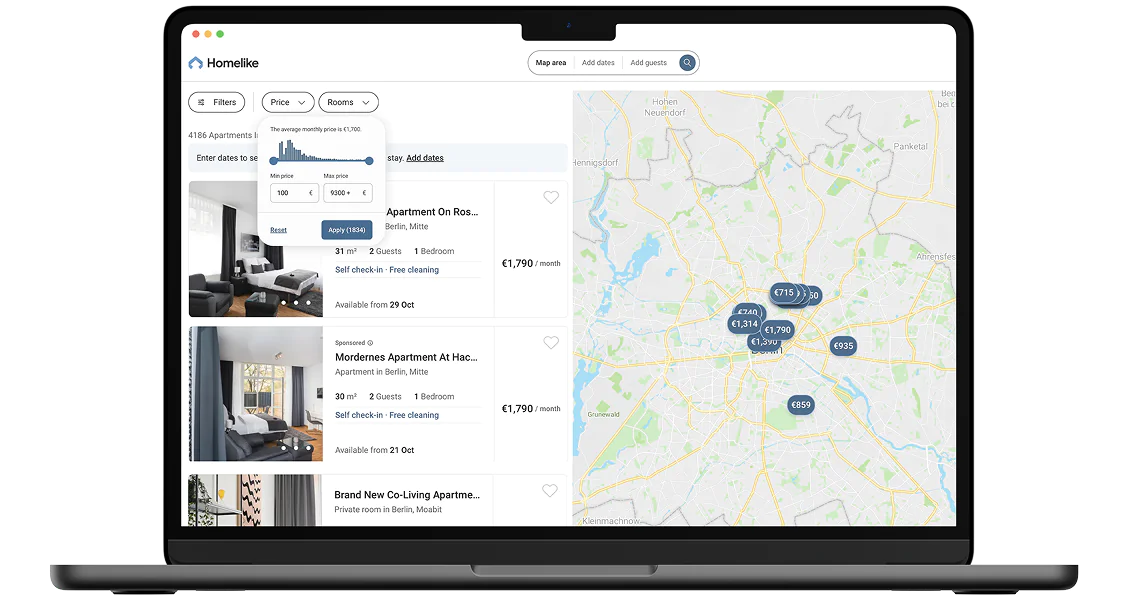
Homelike: corporate housing platform (real estate)
The challenge
Homelike is a German platform for long-term furnished apartment rentals. The team came to us in 2018 to help scale its web platform, and our first job was building feed processors that turn external apartment data into Homelike's internal format.
As the platform grew, new problems showed up. MongoDB-based search couldn't keep up on speed or filtering, payments had to support expansion into new regions, and incoming data needed to reach the frontend reliably. On top of that, a growing base of users, partners, and internal teams kept needing UI/UX improvements.
What we did
For about seven years, our team worked as an extension of Homelike's in-house team. Two to three dedicated frontend developers worked in React, Redux, Next.js, GraphQL, and Apollo Client on the dashboard, the internal admin panel, and UI/UX improvements across the platform.
Along the way, we replaced MongoDB search with Elasticsearch and rebuilt payments as a microservice supporting Stripe, Klarna, iDEAL, and SEPA. We also delivered an external API for B2B partners, an AI-powered chatbot, and validation that checks incoming data before it reaches the UI.
The outcomes
- Document analysis dropped from hours to seconds
- 20,000 documents in one operation, which was the hard requirement the PoC couldn't meet
- Prompt engineering became a repeatable workflow with a testing toolkit behind it, rather than trial and error in a text field
- The security and compliance groundwork is what opened the door to healthcare, finance, and legal customers
- New clients onboard without anyone rebuilding the platform underneath them
Motive Retail: API integration ecosystem (automotive)
The challenge
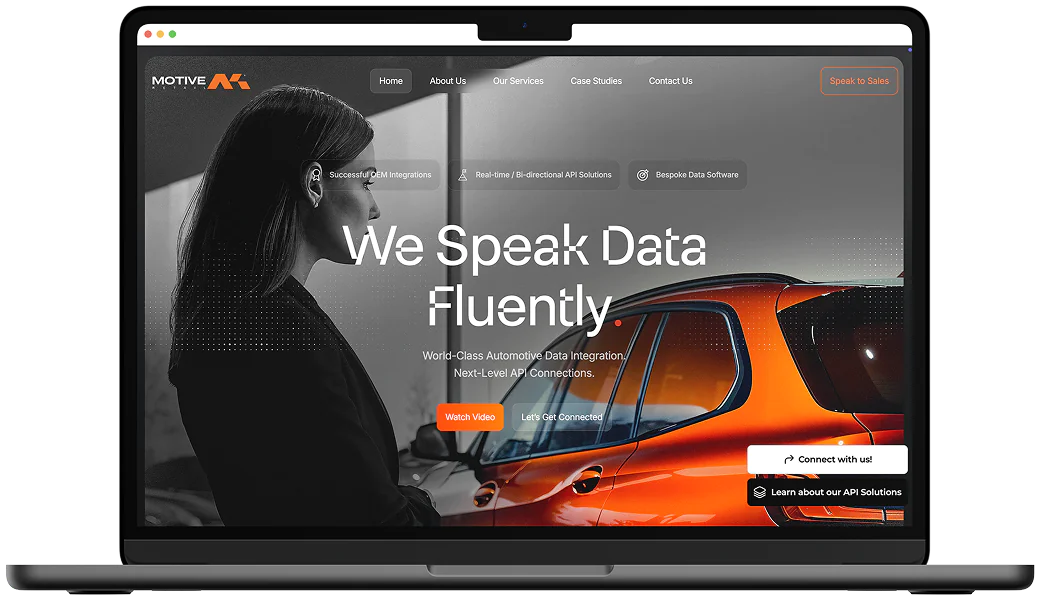
Motive Retail connects OEMs, parts suppliers, dealer management systems, dealers, and insurers through APIs. Both its API integration platform and its desktop certification app needed to evolve. An early move to a Liferay-based portal made the product easier to access, but it also brought performance bottlenecks and a lot of maintenance work. Meanwhile, performance had to stay stable under heavy load for many different user roles.
What we did
We've been modernizing and growing Motive Retail's ecosystem since 2008. The certification app was rewritten into Certify, and the integrator grew into MIX, now the central API platform. We added Activate for subscription approvals, an Admin Panel so the team can manage services without manual database changes, and Console for real-time API traffic analytics.
On the frontend, we moved from Liferay and JavaScript to TypeScript and carried out several major Angular upgrades, up to Angular 19, using NgRx, Material-UI, and AMCharts.
The outcomes
- 17+ years of continuous partnership
- 50M+ transactions handled by MIX every month
- Hundreds of thousands of API requests processed daily through Activate
- 0% deployment failure rate
- 10x faster email delivery in Certify
- Invoice data generation cut from weeks to minutes
ProCC: workforce and crop management for greenhouses (agriculture)
The challenge
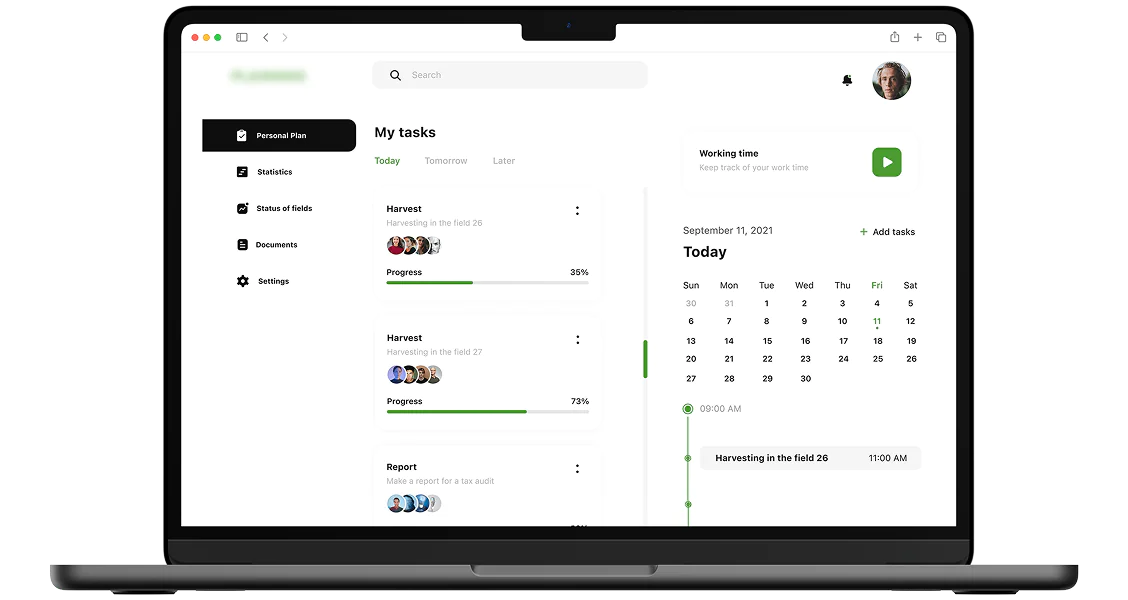
ProCC, a Dutch agritech company, wanted a web app that tracks employee activity during greenhouse harvests using workers' smartphones and Bluetooth markers. Owners needed to plan harvests, assign tasks, keep an eye on fields, measure each worker's performance, and produce reports ready for a tax audit.
What we did
We built the React.js web interface on top of a .NET Core and Laravel backend. It covers scheduled harvest plans, task assignment, real-time field status, worker performance stats, check-in and check-out tracking, live activity paths, and audit-ready reports.
The outcomes
- A concept taken all the way to a viable product
- Real-time visibility into workforce activity and field status
- Each worker's performance evaluated on actual data
- Audit-ready reports that make compliance simpler
- In the client's words, one of the best solutions in the greenhouse market worldwide
We worked with Homelike for seven years and with Motive Retail we've been for seventeen.
Talk to us about a long-term frontend team.
What clients say about working with us

Related software development services

The models, data pipelines, and ML work behind the AI features your users interact with. We handle the part that runs on the server, so the chat, search, or copilot on screen has something reliable to call.

Before anyone writes code, we help you pin down what the product needs to do and for whom. It's especially useful when you're still deciding which AI features are worth building.

Research, user flows, and interface design, including conversational and AI-driven experiences. Our designers hand off work the frontend team can build straight away.

APIs, business logic, and databases that your interface depends on. Pairing it with frontend work means one team owns the whole request, from click to response.

Hosting, monitoring, and upkeep for your application once it goes live.

Manual and automated testing across browsers and devices. It catches problems before your users do, and that matters even more when AI features can return unpredictable output.

If you'd rather hand over the whole product, we take it from discovery through design, development, testing, and launch, then keep supporting it afterward.
Ready to make your frontend AI-ready?
Book a free discovery call and tell our frontend team about your product, the AI features you have in mind, your framework, and your timeline.
Planning a full-stack build? Our backend development services cover the other half. For the models, data, and ML work behind your AI features, take a look at our AI development services. Starting from a blank page? Our custom software development services handle the full build, and our UI/UX design services cover the design work that happens before any code gets written.
FAQ about frontend development services
Rates for frontend web development services usually fall between $50 and $90 an hour, depending on expertise and complexity, but the total really comes down to scope. Updating a component, building an AI feature, and migrating a whole framework are very different projects. AI-assisted engineering can shorten some of that work, and we’ll show you where. Once we understand what you need, we’ll put together a scope-based estimate.
Want a number for your scope? Send us your requirements and we’ll estimate it.
We’ve received your message and will get back to you shortly.